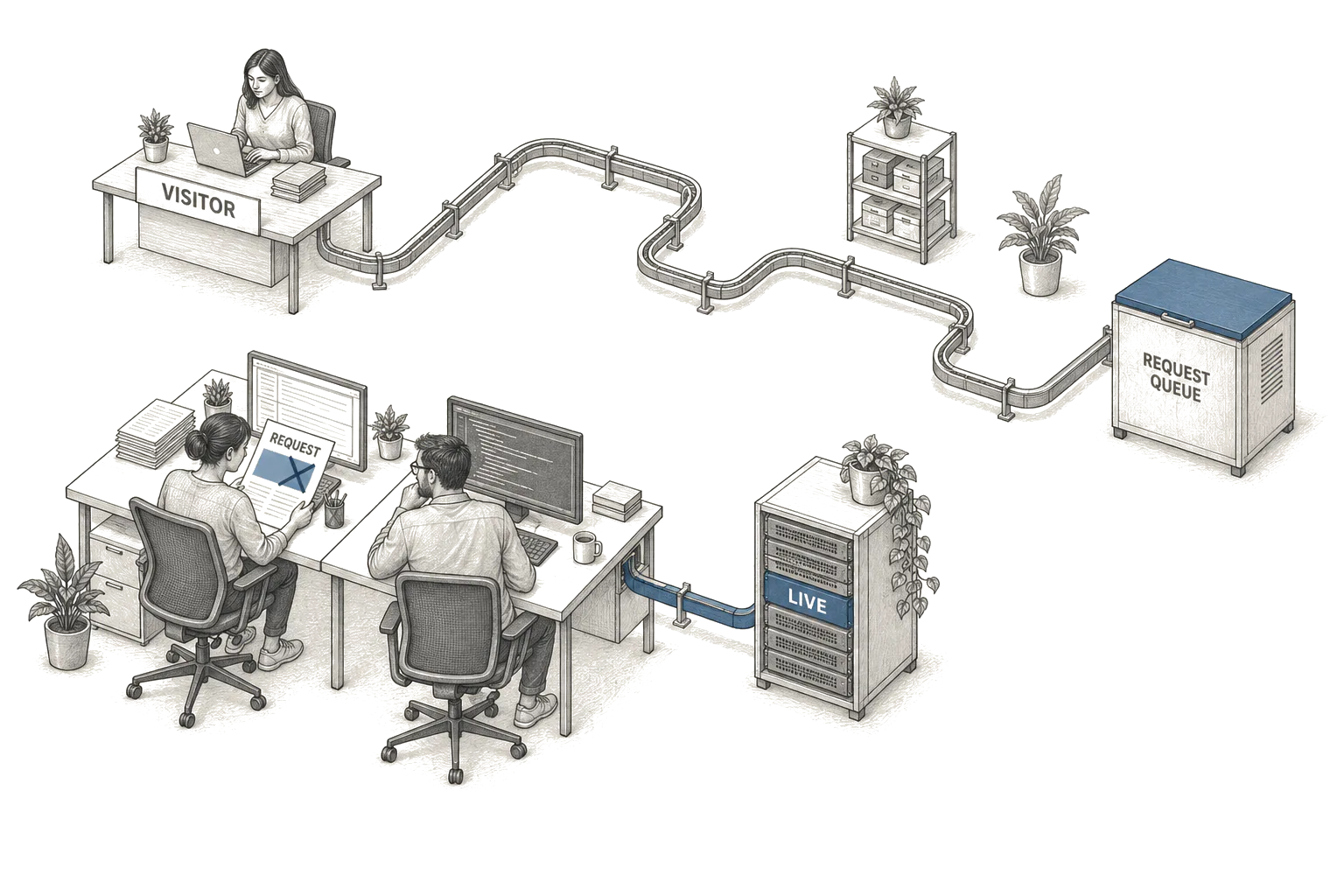
The defining feature is a correction loop, not a client-site desk
Forward-deployed engineering is a delivery model that makes wrong assumptions visible and correctable while work is underway, because the engineers who learn from the customer can change the production system.
The distinction matters when a company is buying help for an AI system whose requirements are unclear in the ways that matter most. A team can spend time in the client’s office, attend every workshop, and still deliver a document that somebody else must turn into a working system. That shortens the commute. It does not shorten the correction loop.
A correction loop is the path from an assumption about the work, through observation of what happens in practice, to a change in the system. Forward deployment is useful when that path needs to be short because a requirement will only become clear when real users, real data, permissions, workflows, and operational constraints meet the software.
Palantir describes having pioneered a role that embeds engineers directly with customers to tackle pressing challenges, and says those engineers own end-to-end execution and implementation. 1 Other firms use similar delivery language. OpenAI describes its team as turning research breakthroughs into production systems. 2
Those descriptions point to the useful test: can the team that discovers a wrong assumption change the design, code, deployment, or operating process that depends on it?
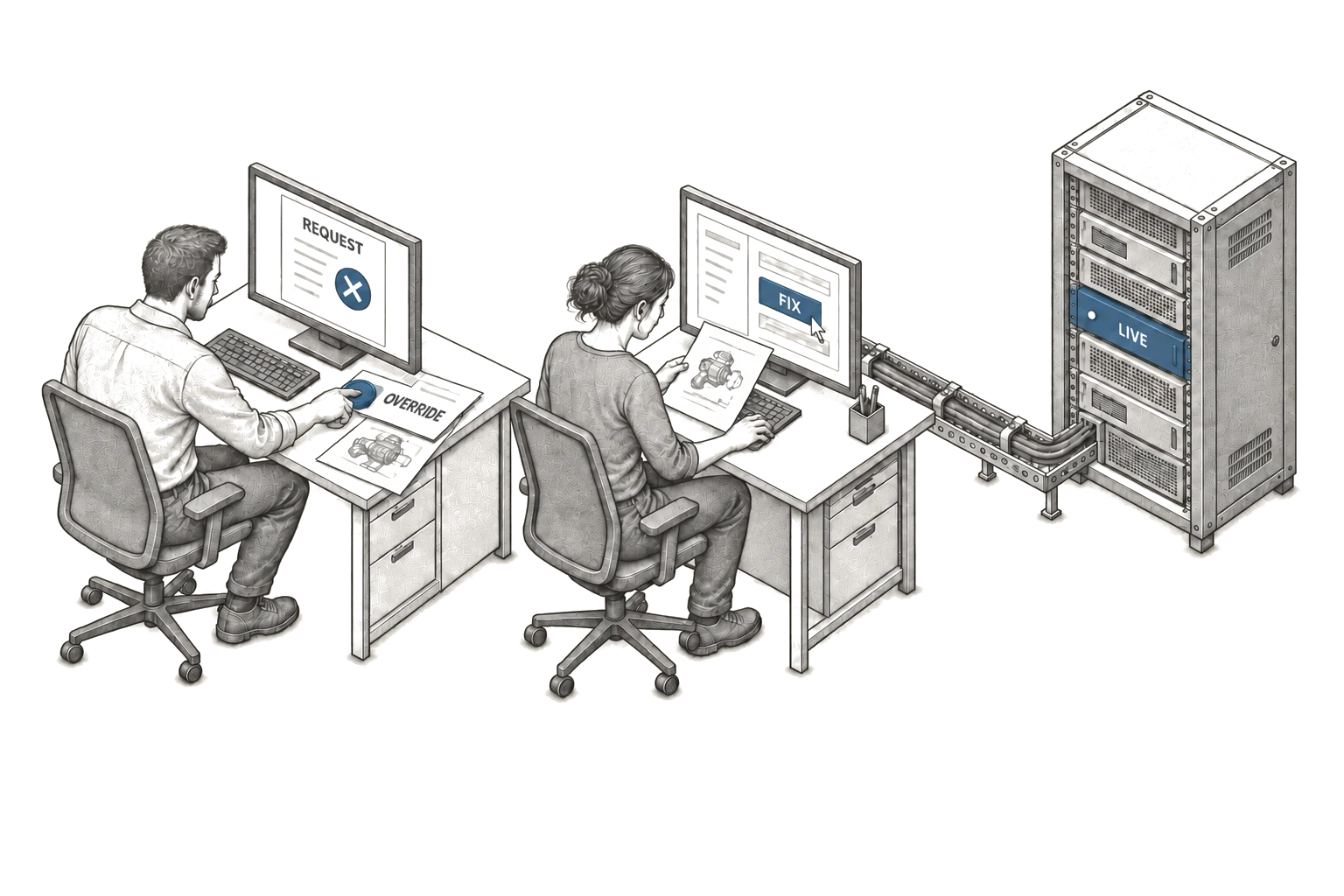
A short loop joins observation to a system change
Consider an AI workflow intended to help an operations team process incoming requests. The initial assumption might be that a request contains enough information to classify it automatically. Once the system reaches real work, the team may find that the decisive information is in an attachment, that users need to override classifications, or that a permission boundary prevents the system from accessing a required record.
A forward-deployed engineer should be able to observe the failure with the users, identify whether it is a workflow, data, technical, or governance problem, and make the relevant change. The change might be a revised interface, an additional review step, a different data integration, a narrower task, or removal of an unsafe automation path.
That sequence is more important than whether the engineer is physically present every day. Physical proximity can help observation happen sooner. It does not grant access to a deployment pipeline, authority to revise scope, or responsibility for the system after the meeting ends.
This is why customer feedback is an engineering capability rather than a ceremonial activity. DORA notes that teams can build for months or years, including across multiple releases, without validating whether features help users. 3 A long correction loop lets an untested assumption accumulate dependencies before anyone challenges it.
The cost is not simply delay. A requirement that proves wrong after interfaces, integrations, training, and operating procedures have been built around it requires changes across each of those layers. Construx reports that correcting defects earlier in feature development can cut development costs and schedules by factors of two or more. 4 The relevant lesson is not that every late discovery has the same multiplier. It is that the cost grows with the work attached to an assumption before it is tested.
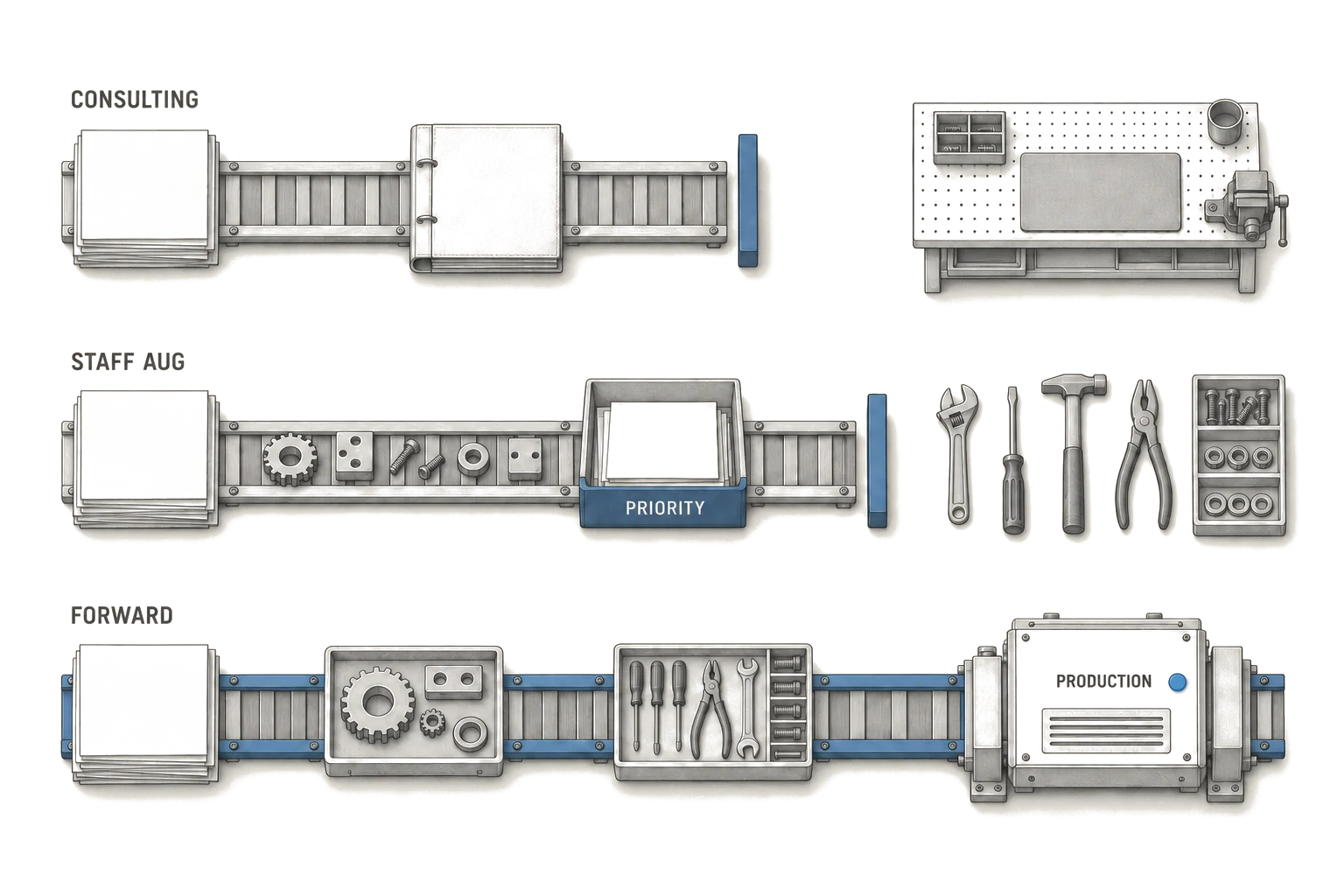
Consulting and staff augmentation break the loop at different points
Consulting, staff augmentation, and forward-deployed engineering can all be useful. They put responsibility in different places, which changes how quickly an observed problem becomes a working correction.
| Delivery model | What the provider is primarily accountable for | Where the correction loop commonly stops | What the buyer must supply |
|---|---|---|---|
| Consulting | Analysis, options, and recommendations | Before implementation | A team to choose, build, and operate the answer |
| Staff augmentation | Assigned labour under the buyer’s direction | At the buyer’s prioritisation and delivery process | Day-to-day direction, technical decisions, and delivery oversight |
| Forward-deployed engineering | A working system and the changes needed to make it operate | Only when access or decision authority is withheld | Access to users, systems, decision-makers, and production constraints |
Consulting is appropriate when the buyer needs an independent assessment, a strategy, or a decision framework. In US federal acquisition rules, advisory and assistance services produce outputs such as information, advice, analyses, evaluations, and recommendations. 5 Those outputs can be valuable, but they leave implementation as a separate handoff. Each handoff adds time between finding a problem and changing the system.
Staff augmentation is appropriate when the buyer already has a clear delivery method and needs additional capacity inside it. The buyer directs the work. The IRS frames the relevant distinction as whether the company controls, or has the right to control, what a worker does and how they do it. 6 That direction can be necessary, but it means the buyer retains the job of turning customer evidence into priorities and shipped changes.
A time-and-materials arrangement makes that oversight particularly important. Federal contracting rules state that this contract structure gives the contractor no positive profit incentive for cost control or labour efficiency. 7 This does not make staff augmentation defective. It makes the division of responsibility explicit.
Forward deployment earns its name only when the provider retains delivery ownership while working close enough to the operation to revise its assumptions. Before selecting it, use What proof should an AI engineering partner provide? to ask for evidence that the provider can carry work through production rather than stopping at a prototype or recommendation.
Set up the engagement so evidence can change the work
A buyer can test whether a proposed engagement has a usable correction loop before signing it.
-
Name the operating decision being tested. Define the workflow step, the user group, and the decision the system will support or automate. “Build an AI assistant” is a technology label, not a testable operating decision.
-
Give the delivery team direct access to the work. This means access to representative users, realistic inputs, the people who own policy decisions, and the systems that constrain deployment. A weekly status meeting is not a substitute for observing the workflow.
-
Give the team authority to make bounded changes. Agree in advance which interface, prompt, integration, process, and deployment decisions the team can revise without waiting for a separate steering process. Escalate decisions that change risk, cost, or business ownership.
-
Define the proof as an operating behaviour. A demonstration should show a real workflow, its failure handling, and who operates it after launch. Make AI vendors prove they can run production systems is useful here because a polished demonstration can conceal an unowned operating boundary.
The engagement should also preserve the ability to stop. A pilot that must succeed will encourage teams to protect the original assumption rather than expose its limits. An AI pilot must be allowed to fail explains why a pilot needs a decision rule that permits ending, narrowing, or redesigning the work.
Four failures that forward deployment should expose early
Forward deployment does not prevent every failure. Its value is that it can identify which failure is occurring before the organisation commits more work to the wrong answer.
| Failure type | What the team observes | The correction required |
|---|---|---|
| Workflow failure | Users bypass the system, override it, or cannot fit it into the sequence of work | Redesign the task boundary or operating process |
| Data and access failure | Required inputs are missing, unreliable, restricted, or unavailable at the needed moment | Change the integration, permissions, data preparation, or scope |
| Decision-rights failure | The team can identify the problem but cannot alter the system or process | Assign authority, reduce approval layers, or change the delivery model |
| Operational failure | The system works in a controlled demonstration but cannot be monitored, supported, or safely recovered in production | Add operating ownership, failure handling, and deployment controls |
The most common buying error is to treat each of these as a model-quality problem. Scale AI describes the hard part of enterprise AI as making systems operate reliably inside complex production environments, rather than building a great model. 8 A stronger model does not resolve an absent permission, an ambiguous policy, or a user workflow that has no place for its output.
Co-location cannot repair missing authority
Physical presence can make conversations quicker. It can also create the appearance of progress when the team is learning faster than it can act.
A controlled study of call-centre employees found a 13% performance increase from home working relative to office-based peers, with about 9% attributed to more minutes worked per shift. 9 That result does not establish a rule for software delivery. It does show that proximity alone is not a general explanation for performance.
Forward deployment fails when the engineers cannot see the work, cannot make changes, or are measured on activity rather than an operating result. It also fails when the buyer cannot provide a bounded problem, a decision-maker, or an environment where the system can be tested safely.
In those conditions, call the engagement consulting, staff augmentation, or discovery work. Calling it forward-deployed engineering does not create the correction loop that the work lacks.