
The required output determines which system you need
Automation executes a decision already specified, predictive AI estimates an unknown quantity from history, and generative AI produces a candidate artifact that still needs checking. These systems answer different questions, even when vendors group all three under AI.
“Traditional AI” is too broad to guide a purchase. It can refer to predictive models, which learn patterns from data, or to rule based automation, which follows instructions written in advance. The useful distinction is the output: an executed decision, an estimate, or a new artifact.
Choosing the wrong class creates verification cost, meaning the labor, tooling, and delay required to establish that an output is fit for use. That cost follows from the type of output. It cannot be removed later by improving the interface or rewriting the prompt.
A national standards definition supports this output based distinction. NIST describes AI systems as producing predictions, recommendations, or decisions, while defining generative AI separately as models that produce derived synthetic content. 1 2
Use this decision procedure before discussing models or vendors:
| Stage | Question to settle | A good answer | What a bad answer conceals |
|---|---|---|---|
| First | What exact output must the system produce? | One concrete noun, such as approval, forecast, or draft | Several jobs have been bundled into one AI project |
| Second | Can written rules fully determine the output? | The same valid inputs always require the same action | A discretionary judgment is being disguised as a rule |
| Third | If rules are insufficient, can history estimate the unknown? | Past observations contain a measurable relationship to the target | The team has data, though not data that represents the decision |
| Fourth | Is the required output new content? | The system must create text, images, audio, video, or code | Generation is being selected because its interface is convenient |
| Fifth | Who will verify each output, and against what evidence? | An owner, check, fallback, and acceptable error are named | Review work has been omitted from the business case |

First, name the output before naming the technology
Start with the noun that leaves the system. “Improve customer operations” is not an output. “Approve a refund,” “estimate next month’s demand,” and “draft a refund explanation” are outputs.
This wording exposes composite projects. A single customer service workflow might need automation to apply an eligibility policy, prediction to estimate the chance of repeat contact, and generation to draft a response. Calling the whole workflow generative AI hides the controls required around each part.
Take an illustrative case: a customer operations director kicks off a project to "use generative AI to improve renewal handling." Pressed for the actual output, the team is really asking for three separate things: a rule that checks whether a contract is even eligible for renewal, a forecast of which accounts are likely to churn, and a drafted renewal email a rep can send. Naming the project generative AI concealed two decisions that had nothing to do with generation.
The output also identifies the person who can judge success. A policy owner can confirm whether an automated decision followed the rule. An analyst can compare a forecast with the observed quantity. An editor or subject expert must inspect a generated artifact for factual and contextual errors.
If the meeting cannot produce a concrete output, pause the technology choice. When should a business not use AI? applies before model selection because an unclear decision remains unclear after software is added.
Second, use automation when the decision can be written down
Automation is software that performs a predefined action when specified conditions occur. A rules engine, meaning software that evaluates explicit conditions such as eligibility thresholds, is deterministic when the same inputs and rules produce the same result.
A good automation candidate has authoritative inputs, complete rules, and defined exceptions. The main verification work happens before release: test each rule, confirm precedence where rules overlap, and record which rule produced each action. Operations still need monitoring, though individual outputs do not require fresh interpretation when the inputs and rules are valid.
A bad automation candidate contains phrases such as “use judgment,” “normally approve,” or “unless the case looks unusual.” Those phrases conceal decisions that have not been specified. Encoding them as expanding exception lists makes the system harder to inspect without resolving the underlying ambiguity.
A procurement analyst who writes “approve unless the request looks unusual” into a specification has not written a rule. They have hidden a judgment call inside a phrase that only sounds like one.
Regulators also recognize the distinction between learned systems and narrow procedural work. The EU AI Act describes tasks such as transforming unstructured information into structured information or classifying incoming documents as narrow procedural tasks. 3
Third, use prediction when history can estimate an unknown
Predictive AI uses a model, meaning a mathematical relationship learned from sample data, to estimate an unknown quantity. The Bank of England and Financial Conduct Authority describe machine learning as building a model from data to make predictions, recommendations, or decisions without every rule being programmed explicitly. 4
A good prediction target is observable after the estimate is made. Demand, failure, delay, and default can eventually be compared with what occurred. The buyer can therefore define the error measure, test the model on held out data that was excluded from training, and monitor whether errors change after deployment.
The prediction does not become a decision until someone specifies what to do with it. A forecast of demand is an estimate. A rule that increases inventory when the forecast crosses a threshold is automation. Combining them is reasonable, though each part needs separate verification.
Prediction is a poor fit when the historical record does not represent the future decision. Missing outcomes, changed policies, selective data collection, or rare events can make a precise score look more informative than it is. The right response is to expose the uncertainty and define a fallback, not to turn the score into generated prose.
The National Hurricane Center shows what operational prediction looks like when error is explicit. Its forecast cone is sized from historical forecast errors so that two thirds of past official forecasts fall within the relevant circles. 5 The published uncertainty is part of the output, rather than an inconvenience hidden behind it.
Fourth, use generation when the output must be a new artifact
Generative AI is a class of model that learns characteristics of input data and produces derived synthetic content. Its natural output is a candidate email, image, report, software patch, or other artifact.
A good generation task has more than one acceptable answer and a practical way to inspect the result. Drafting a product description can fit because an editor can compare the claims with approved product data. Reformatting notes into a proposed report can fit because the source material remains available for comparison.
A generated artifact is not self verifying. Provider documentation states that identical requests can produce different outputs even when temperature, the setting used to reduce sampling randomness, is set to its minimum. 6 Repeated tests therefore establish a range of behavior, rather than proving that the next output will match the last one.
That variability becomes dangerous when generated content enters a control loop, meaning a process where an output directly changes a system or real world state. Keep generative AI outside deterministic control loops explains why a checked proposal and an automatically executed instruction require different safeguards.
Generation also receives class specific regulatory treatment. The EU AI Act requires providers of systems that generate synthetic text, images, audio, or video to make those outputs machine readable and detectable as artificially generated or manipulated. 3 That obligation exists because the system creates content, not because it merely executes a rule or reports an estimate.
Fifth, price verification before comparing implementation cost
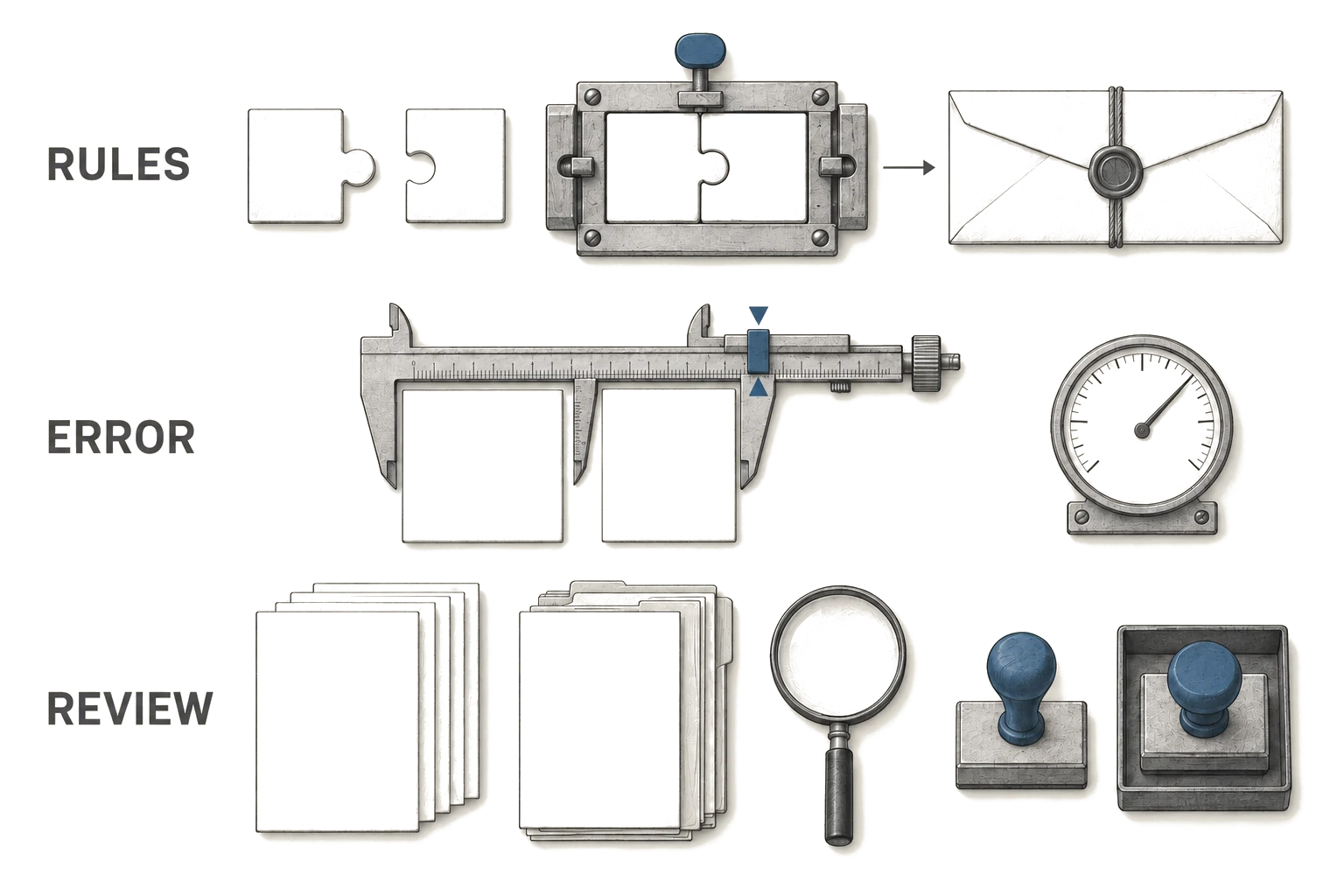
Each class moves verification to a different place. Automation concentrates it in rule design, branch testing, and exception handling. Prediction concentrates it in data quality, error measurement, and monitoring. Generation adds inspection of candidate artifacts during operation.
This difference changes the business case. A generator may shorten drafting while creating a continuing requirement to check factual claims, citations, tone, permissions, and downstream actions. How much of my team's time will checking the AI take? should be answered before committing to a generated output.
The verification plan should name the responsible person, the evidence available to that person, the failure response, and the record retained. “A human will review it” is incomplete. It conceals whether the reviewer has the source material, authority, time, and interface needed to reject the output.
Take a contracts reviewer told that a generative system will draft renewal notices and “a person will review them.” If that reviewer has no access to the original contract terms, no time budgeted beyond a glance, and no authority to send a draft back for a rewrite, the review is not a control. It is a signature on somebody else's guess.
High stakes professional content can make this omission decisive. In a Stanford evaluation of specific legal queries, the models studied produced confident false statements, called hallucinations, at rates ranging from 69 to 88 percent. 7 That result does not establish an error rate for every legal task or current model. It does show why legal generation requires claim level checking against authoritative sources.
Governance should preserve the evidence produced by these checks. AI governance should produce evidence, not only policy becomes relevant once the team must prove which rule ran, how a prediction performed, or who approved a generated artifact.
The alternatives move cost rather than removing it
Replacing automation with prediction adds training data, error tolerance, and model monitoring to a decision that could have been fully specified. The system can now vary around a boundary where the business already knew the answer.
Replacing prediction with generation can produce a persuasive explanation without establishing that the underlying estimate is accurate. A fluent paragraph can describe a forecast with total confidence while carrying none of the error bounds that made the forecast checkable in the first place.
Replacing generation with templates reduces variation and checking, though it also narrows the range of acceptable outputs. That trade is often useful for regulated notices, contractual language, and operational commands where controlled wording matters more than novelty.
Replacing an uncertain judgment with automation creates a different failure. The missing judgment reappears as manual exceptions, unexplained defaults, and rules that conflict. The implementation looks deterministic while its policy remains unresolved.
Hybrid systems break labels unless each output is classified separately
The procedure classifies the deployed output, not the model’s marketing category. This matters because one model can perform more than one kind of task.
Research has shown that large language models, which are models trained to generate sequences such as text, can forecast time series without task specific training at a level comparable to or better than purpose built forecasting models in the reported experiments. 8 If such a model emits a numerical forecast, evaluate it as prediction. Measure forecast error and drift rather than checking whether its explanation sounds plausible.
A chain can also cross categories. A model might draft a recommendation, a rule might approve it, and an automated service might execute it. Checking only the first output misses the consequence created by the full chain. Each transition needs an owner and a failure response.
The procedure also fails when no trustworthy check exists. If rules cannot specify the decision, history cannot support an estimate, and experts cannot verify a generated artifact, none of the three classes makes the task safe. Approving the project at that point converts unresolved uncertainty into operating cost and leaves the eventual reviewer to absorb it.